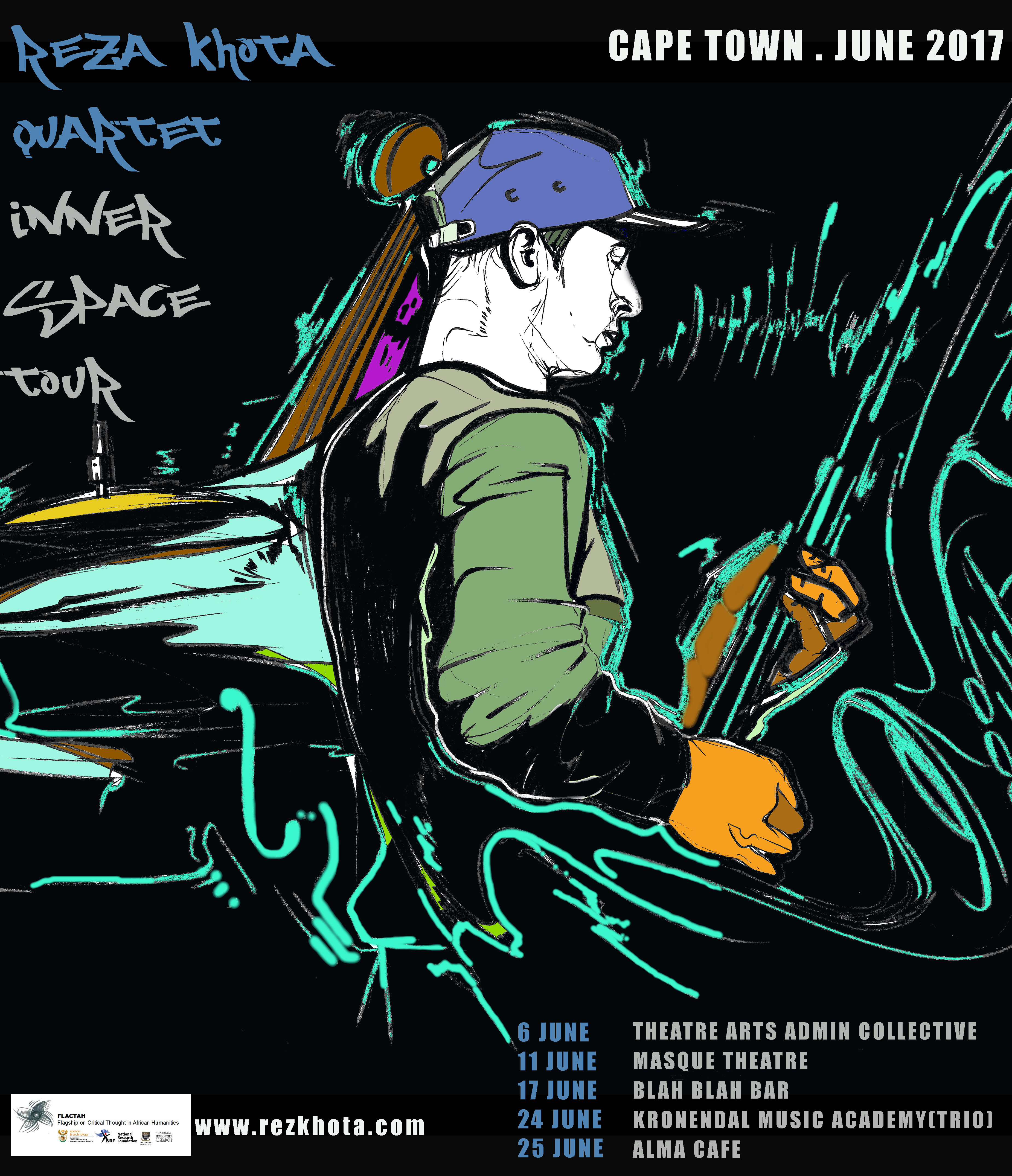

Reza Khota is a guitarist/composer who has performed, recorded and toured professionally in South Africa and Internationally for over 25 years. His albums have been reviewed and recognised in the global jazz media. Over the years he has established himself as a guitarist with wide reaching abilities. He has two releases as band leader of his own quartet, several others in collaborative bands and features as a guitarist on many more. The Reza Khota Quartet released their second album – Liminal, in 2019. It features long time collaborators: bassist Shane Cooper, drummer Jonno Sweetman, and Saxophonist Buddy Wells. Khota recently features on albums by Tumi Mogorosi, Gabi Motuba, and on a forthcoming release by the newly formed free-jazz trio Proof of Life with drummer Asher Gamedze and bassist Sean Sanby. Khota is also the bandleader of the Polyrhythmic Ensemble alongside fellow guitarist Vuma Levin, bassist Sean Sanby, and percussionist Gontse Makhene. The ensemble develops upon Khota’s PhD research into modal and contrapuntal African guitar music, and has become a working ground to test contrapuntality as a generative compositional and improvisational methodology.
Khota was an artist in residence at the University of Western Cape’s Centre for Humanities Research from 2015-2018. In 2025 Khota completed a joint PhD in History at the University of the Western Cape, and in Art Science at the University of Ghent. His thesis reframes histories of West African guitar music, taking a contrapuntal approach to reading its musical forms in relation to the historical background of slavery, colonisation, emancipation and independence. It also presents a contrapuntal method for composition/improvisation from a South African positionality that moves beyond the taxonomic modes of representation historically practised within the discipline of ethnomusicology.
Khota currently holds a postdoctoral fellowship with the The British Academy/NRF UK-SA Bilateral Digital Humanities Chair in Culture and Technics at the Centre for Humanities Research at UWC. His work as part of a cohort of scholars posits a renewed aesthetic education both as an intervention into the relationship between the human and technology and as a basis for reimagining a post-apartheid future.

